 English
 简体中文
 한국어
 Bahasa Indonesia
 Español
 Français
 Tiếng Việt
 ไทย
 日本語
 العربية
 Kiswahili


A decimal price of 2.50 does not mean you win 2.50 units in profit for every unit staked. It means a winning one-unit stake returns 2.50 units in total, including the stake.[1][2] Separate total return, profit and implied probability, and the number becomes much easier to read.
Quick answer: For a standard winning single, total return = stake × decimal odds.[2] Profit = total return − stake.[2] The reciprocal of the price gives a raw implied probability.[1] It is not a forecast of what will happen.
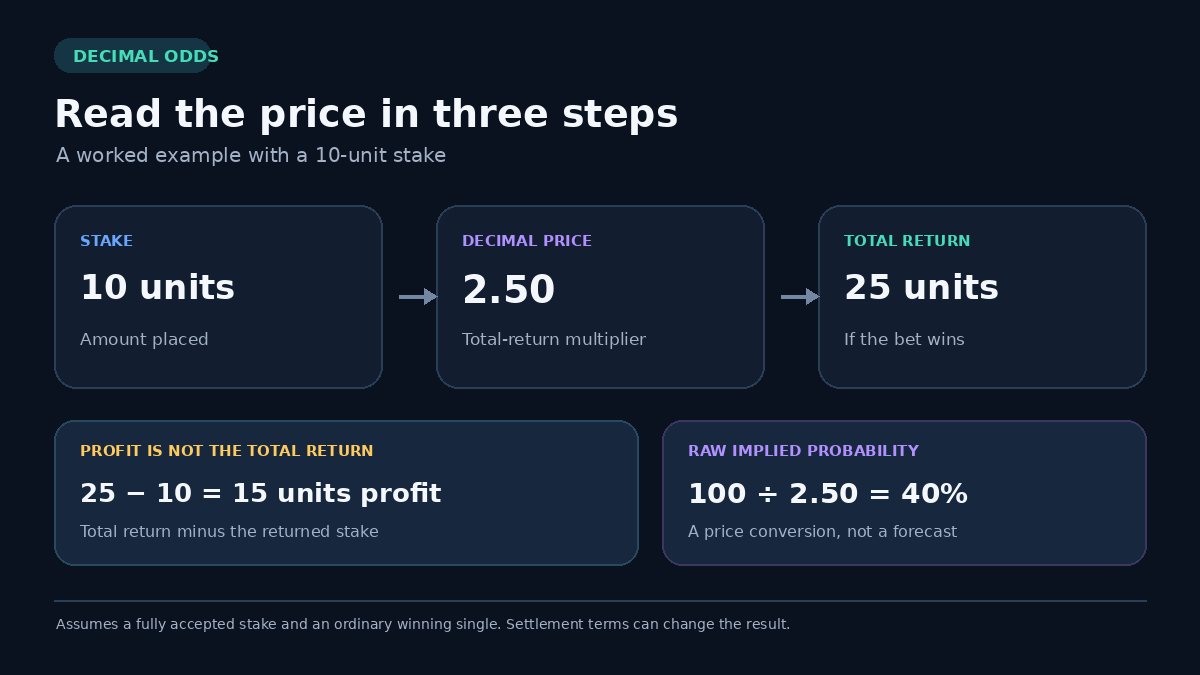
What the decimal number represents
Decimal odds are a multiplier for the total payout on a winning stake. The original stake is included in that total.[2]
For example, at 2.50 odds, each 1 unit staked returns 2.50 units if the selection wins: 1 unit is the returned stake and 1.50 units is profit.[2] If it loses, an ordinary single-bet settlement returns nothing and the stake is lost. Market rules can differ for voids, pushes, partial settlements and other bet types, so check the specific market before applying the simple formula.
Calculate total return and profit separately
Use these two formulas for a standard winning single.[2]
- Total return = stake × decimal odds
- Profit = total return − stake = stake × (decimal odds − 1)
At 2.50 odds with a 10-unit stake, total return is 10 × 2.50 = 25 units. Profit is 25 − 10 = 15 units.[2] Calling the full 25 units “profit” counts the original stake twice.
| Decimal odds | Total return on 10 units | Profit if it wins | Raw implied probability |
|---|---|---|---|
| 1.50 | 15 units | 5 units | 66.67% |
| 2.00 | 20 units | 10 units | 50.00% |
| 2.50 | 25 units | 15 units | 40.00% |
| 4.00 | 40 units | 30 units | 25.00% |
The table uses the same stake for each row. It assumes the bet is accepted in full and settles as a normal win, with no deduction, commission, void leg or partial settlement.
Convert the price to a raw implied probability
For decimal odds, the basic conversion is 100 ÷ decimal odds.[1] At 2.50, that is 100 ÷ 2.50 = 40%.[1]
This is a price conversion, not evidence that the outcome has a true 40% chance of happening.[1] In a bookmaker market with several mutually exclusive outcomes, adding the raw implied probabilities can produce a total above 100%; the excess is associated with the market margin, also called overround.[3] A margin-free estimate requires the prices for all outcomes and a stated method for adjusting them.
For a simple all-or-nothing bet with no fees or push, the reciprocal is the break-even win rate for that price.[1] If the settlement can return part or all of the stake, this shortcut alone does not describe the full break-even calculation.
A quick check before comparing prices
- Confirm that the displayed number is decimal odds.
- Multiply the accepted stake by the price to find the total return if it wins.
- Subtract the stake once to find the profit.
- If using the reciprocal, label it raw implied probability rather than the true chance.
- Compare prices only when the selection, line, time period and settlement terms match.
The useful distinction is simple: decimal odds tell you the payout multiplier; the reciprocal translates that price into a percentage.[2] Neither calculation, by itself, tells you whether an outcome is likely or whether the price is good value.[3]